
143 Year Old French Town Hall Survived Two World Wars… RIOTERS Burnt it to the Ground
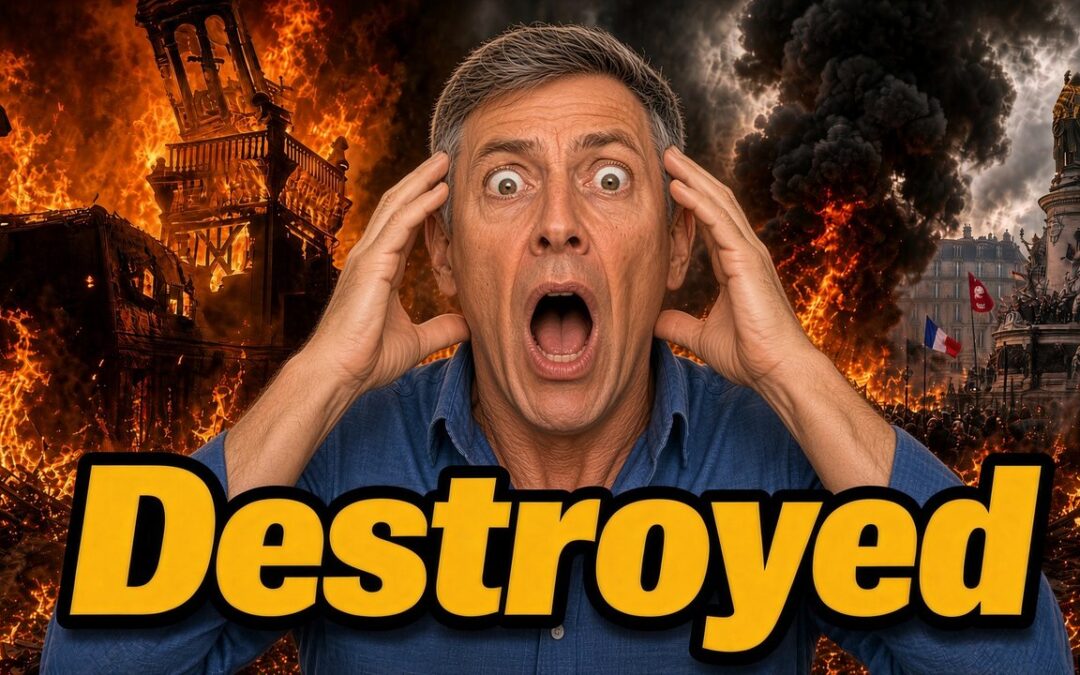
“The building that outlasted the Wehrmacht and the RAF did not outlast the people who treat public order as optional and historic masonry as an ambient prop for their politics.”
The Limoges town hall was built in 1883. It stood through the Franco-Prussian War, two world wars, the Occupation, the Liberation, de Gaulle, Mitterrand, and the various financial panics that periodically remind the French that arithmetic still exists.
It did not survive a Saturday afternoon of “cost-of-living protests” in 2026. Masked ultra-left types and opportunistic looters forced their way in, set the fire, and watched the roof and most of the facade collapse.
Officials called it a catastrophe for heritage. The building that outlasted the Wehrmacht and the RAF did not outlast the people who treat public order as optional and historic masonry as an ambient prop for their politics.
This is the pattern now. The temperature rises, the marches begin, the black blocs and the looters attach themselves, the fires and the broken glass follow, the arrests are made, the government expresses grave concern, and then everything calms until the next cycle. Each time the floor is a little higher. Last year they burned thousands of cars and bashed in shop windows, now they’ve upped the ante to 19th-century civic architecture.
What used to be contained in a few banlieues, slums outside the cities, is now visible in provincial centers. The authorities respond with the usual combination of tear gas, eventual prosecutions, and an evident reluctance to look “heavy-handed.” Looking heavy-handed is apparently worse than letting a building that survived two world wars burn to the ground.
If the same people had shown up under Marine Le Pen banners, the institutional response would have been different in both speed and volume. The coverage would not have spent equal time on the “root causes” and the police response.
There would have been less interest in whether the stun grenades were proportionate and more interest in whether the organizers had finally revealed their true character. When the violence comes from the ultra-left and the usual mix of delinquents, the framing remains that the real problem is inequality, underfunded schools, or the lingering effects of colonialism. When it comes from the right, the problem is the right. The difference is not subtle and it is not accidental.
The same soft touch has governed the longer story. France imported labor from the Maghreb for the factories and the construction sites of the Trente Glorieuses.
When the temporary workers stayed and brought families, and when later inflows continued under family reunification and asylum rules, large parts of the political class treated the resulting communities as a clientele rather than a population that would have to adopt the secular, low-trust, high-tax rules of the existing society.
The surveys are not ambiguous. Significant minorities of French Muslims, and majorities of the younger ones in the latest Ifop data, rank religious rules above republican law on concrete questions and express sympathy for Islamist currents.
Public majorities have long told pollsters that Islam as practiced is incompatible with the Republic. The political answer was not to treat that as information. It was to expand the welfare state, raise the tax burden, and describe resistance as racism.
The result is a country whose government sons or accounts for 57 percent of GDP, runs persistent major deficits, carrying debt north of 115 percent and rising, and still cannot maintain basic order in its own streets or protect its own town halls.
When I was in Paris, I met a the owner of a dry cleaning shop, who works 60 hours a week, and is able to clear profit that barely outpaces the combination of welfare given out to those who choose leisure, drugs, video games, ie. to not work, god bless their hearts. They expressed great resentment, and wondered aloud, why should they continue, being forced to pay for the sloth and lazy.
The nuclear family and the older cultural inheritance are treated as optional or oppressive. The buildings that embodied the older inheritance are treated as disposable when the correct people set them on fire.
The left’s promise was always that the old constraints—on family, on identity, on spending, on who could live here under what terms—could be discarded and that something better would appear in their place. What has appeared is higher violence, higher debt, no incentive to produce or work, and a growing share of the population that does not accept the legal and cultural premises of the country that hosts it.
None of this required a conspiracy. It required a series of decisions that treated labor shortages as permanent, assimilation as optional, fiscal limits as negotiable, and public order as secondary to the feelings of the people most likely to disrupt it. The town hall in Limoges is simply one more piece of evidence that those decisions have consequences, and that the people who made them still prefer the consequences to the appearance of having changed their minds.
Connect with us
Popular posts

This Nigerian Immigrant or Ilhan Omar? You Make the Call
Brandon Tatum discusses whether or not you would rather have this beautiful Nigerian immigrant, or America hating islam Ilhan Omar within the country….

‘Free Palestine’ Means No Israel
“If Hamas laid down its weapons and released the hostages, the shooting would stop. If Israel laid down its weapons, the result wouldn’t be a kumbaya picnic — it would be slaughter, followed by the usual claims that the victims had it coming.”
French Rioters ATTACK Police in MOSTLY PEACEFUL Protest
French rioters, Muslims and communists/ leftists attack police vans and shielded police in what the BBC and MSNow will describe as “mostly Peaceful” p…

“France is COOKED” – Macron’s National Address Turns into a Surrender
“France is burning — and Macron is calling for calm. But will his promise of ‘concrete solutions’ be enough to stop one of the country’s worst outbreaks of unrest in years?”
Featured post

Google Declares itself Evil as YouTube SABOTAGES Competition
Google is no longer do no evil company but one that is actively installing an Orwellian nightmare dystopia upon our society and the world.
Latest posts
This Nigerian Immigrant or Ilhan Omar? You Make the Call
Brandon Tatum discusses whether or not you would rather have this beautiful Nigerian immigrant, or America hating islam Ilhan Omar within the country….
‘Free Palestine’ Means No Israel
“If Hamas laid down its weapons and released the hostages, the shooting would stop. If Israel laid down its weapons, the result wouldn’t be a kumbaya picnic — it would be slaughter, followed by the usual claims that the victims had it coming.”
French Rioters ATTACK Police in MOSTLY PEACEFUL Protest
French rioters, Muslims and communists/ leftists attack police vans and shielded police in what the BBC and MSNow will describe as “mostly Peaceful” p…
“France is COOKED” – Macron’s National Address Turns into a Surrender
“France is burning — and Macron is calling for calm. But will his promise of ‘concrete solutions’ be enough to stop one of the country’s worst outbreaks of unrest in years?”

0 Comments