
My Wife Worked at France’s Top Secret Atomic Lab – Then Brought Isotope Science to Communist Poland
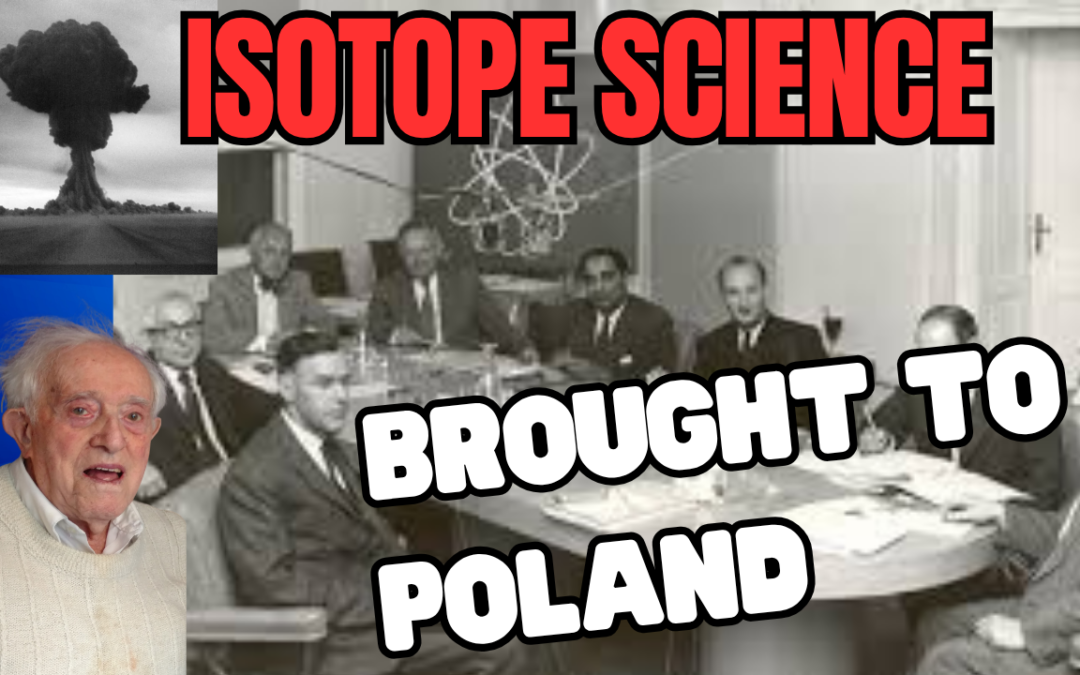
When Helena visited Soviet institutes seeking knowledge about isotopic research, officials repeatedly claimed the director was unavailable — then whisked her off to art galleries, where she unknowingly viewed hidden masterpieces by Picasso and Matisse, kept secret from the public.
My wife, Helena, was in ’57 and working in Saclay, this was, the Atomic Energy institute in France, created by de Gaulle. And, she became the… also very friendly with some of the principal forward. Because I think he was the head of the biological department of the, of the Institute. And we continued to be very friendly with him, and meeting him all the time whenever, we came to France. For some reason, he didn’t decide to come, to Poland, but, we continued our friendship for as long as he lived. because he died, quite young, in the ’80s, of pancreatic cancer and it was a very, big loss for us too. So, I imagine this because in many ways, he tried to help us whenever there was a need for that and he’ll and I will say that it wasn’t financial but, of course, but in a way which he could, and which we needed maybe.So when Helena came back from France, she before that started, organizing, I mean, a lab at, on plant metabolism. But, in, when she came back, she continued to work at the plant, at the level of metabolism but, she, also, started organizing the Central Isotope Lab in the Institute, where she was working in, as a professor and a research, and a, and a, and a research person in Plant Physiology Department. It took a long time to organize this lab, especially in building the glasshouses, with which we controlled the environment, which I think I talked about this before. someone… Later in ’63, she got a prize for that from the, from the, State Atomic Agency for Peaceful Use of Atomic Energy, for her work in organizing the, in the use of isotopes in Poland.Before that, she also tried before that to get some information from the institutes in Soviet Union. But when ever she came there, the institutes didn’t especially like to show anything related to atomic energy and peaceful use, and it happened many times when she went especially to the Petersburg Institute, I think it was the Institute of Plant Physiology there, – and they tried to tell her many times that, whenever she came, that the director’s not in, and then she to come next day, next day, next day. And, instead of showing her the work on the, on both atomic use for, of isotope use and so on, and, they, took her to the, to the art galleries in, and she was spending quite a lot of time, there.Then, and then finally she decided to come home. She also got acquainted with, a lot of art which had also accumulated in the Soviet Union which was not, actually shown. And, but it was kept hidden in special, in special rooms behind the, those, which were available for visiting by the people. so, and there was a lot of, western art there, especially of Picasso, Matisse and other ones, which were not at the time shown. largely or were, or were, or more- Or more at all, to the public. so, her visit to France and to the Institute was very helpful for work which she did and to some degree also for my work which I did.I organized a field research lab for my department at the university in a state close to Warsaw. The lab was located on a large farm owned by the university, but it was not developed at all. Together with my colleagues, I started arranging the whole field of research focused on crop rotations, soil fertility, structural and mechanical properties of soil, weed control, and other problems related to general agriculture and plant-soil relations, especially methods of tillage.I also organized another research field for potato studies on a different farm in another state, called Adveshkin. The first one was called Khelitsya. We organized it for the Department of Potato Research at the Institute of Plant Growing, Cultivation and Fertilization. There, I built a large warehouse for potato preservation during wintertime, with regulated environment and facilities for isotopic studies on potatoes.I managed all these fields until 1967, when a special Institute of Potato Research was formed. The institute was built in Koszalin. I did not move there with the institute but stayed with the labs I had organized in Warsaw and in the other region, until I had to leave Poland.At that time, I started attending various international meetings and taking part in international work in all aspects depending on the subject. After some time, my friends and I became principal organizers of some of these meetings. I also started being head of various departments in these organizations. For instance, I became head of the Department of Agronomy of the European Journal of Potato Research. In this way, I got acquainted with a lot of scientists in various fields of work.In 1959, I received a FAO fellowship to visit western institutes. I worked in Wageningen at the Department of Agriculture at Wageningen University in the Netherlands, and then at Rothamsted Experimental Station in England, the oldest experimental station in Europe. I also visited a number of institutions in West Germany and got acquainted with the professors there. I stayed at Rothamsted for about half a year or more, from 1959 into the beginning of the 1960s.At that time, Helena went by boat from Poland to Canada with our son to attend the 12th Botanical Congress in Montreal. She first assumed the proceedings would be mostly in French and she knew French like a native, but she soon realized that almost everything was in English, so she had to switch to English.While I was at Rothamsted, we decided that she and our son would come to stay with me for a month. The ship journey took almost a month each way. I had to go to the port (not in London but somewhere else) to meet them. The administration at Rothamsted was very helpful, and one of the scientists there also helped me greatly. We had a long discussion with officials from the foreign ministry, but they finally agreed to let them stay with me. We then returned to Rothamsted, and our son stayed with me for some months. We sent him to school there. He was 11 years old at the time, and the other children were not very helpful—quite the opposite—so he was not very pleased. After a few months, they took the boat back to Poland. I stayed at Rothamsted for quite some time—more than half a year in total. When I returned, I brought additional knowledge of various European problems in agriculture.I do not remember exactly when it started, but around that time I was helpful in creating the Polish Academy of Sciences. After I came back in the 1960s, I was nominated as deputy secretary of the Department of Agriculture and Food Processing at the Academy of Sciences. I actually worked as the acting secretary until 1967 or the beginning of 1968.In 1967, I created a new lab for soil fertility measurement and management, which belonged to the Academy of Sciences.In 1961, I organized an international exhibition in Prague, Czechoslovakia, on methods and tools for the measurement of soil structure, fertility, and physical and chemical properties. Out of all the exhibition participants, I received a gold medal for my work. At that time, I also wrote a book together with an East German corporation. It was published in four languages and covered methods of measurement of soil properties, including soil fertility, soil structure, and physical and chemical methods. In addition, I wrote a two-volume textbook for students with laboratory exercises on these problems, as well as on weed control and crop rotations.In 1961, I was elected by the faculty as an ordinary (full) professor. The election was confirmed by the Minister of Higher Education and finally by the State Council, whose chairman was the president of the country at that time, Aleksander Zawadzki. Helena became a full professor in 1964.In 1962, I was elected a corresponding member of the Polish Academy of Sciences by the general meeting of the members of the Academy. This was also confirmed by the State Council at the end of the year.During that period, I attended many meetings, and most of my contributions were published in the Annals of Agricultural Sciences or in the language of the country where the meeting took place. We also hosted quite a large number of foreign guests, both from the East and from the West.At that time, we started thinking about a larger apartment, but Helena wanted to build a new house instead. It was quite an additional task. She wanted it in the villa part of Warsaw, in the upper Mokotów district. It was very hard to get a plot there because the area was almost fully built, but I somehow succeeded in getting one in Ujazdów. Then we had to find an architect to design the house.I will talk about this and other matters later, because I have to stop here for now.
Connect with us
Popular posts

The Left’s “Modern Lynching” Stories That ALWAYS Collapse | But they Keep Pumping
“We on the left have an infinite demand for racism and victims of it. For me, it’s the Benjamins. For them, it’s the halo. Same product. Different packaging.” A jaw-dropping confession from inside the racial grievance industry.

She Left Him Dead in the Street. The Judge Gave Her a Month
Q’Laundra Hood ran a red light, killed a man, drove away, and got 30 days. Tou Thao stood in a crowd during George Floyd’s arrest and got years. One question remains: is this equal justice?

Communist Lesbian in CRISIS – From The Last Ditch to Clown College
“When the owner mentioned she was sleeping in her car and drowning in debt, they accused her of spilling White Tears — because in this world, a missing Instagram caption is a war crime and an unpaid tab is praxis.”

Reverse the Races and This Is “A Window Into America”
“Bert Atienza went to church, Walmart, then directly to the morgue. That is the whole American dream in three stops.” A Filipino-American grandfather asked a teenager for basic courtesy — and a family beat him to death for it.
Featured post

Google Declares itself Evil as YouTube SABOTAGES Competition
Google is no longer do no evil company but one that is actively installing an Orwellian nightmare dystopia upon our society and the world.
Latest posts
The Left’s “Modern Lynching” Stories That ALWAYS Collapse | But they Keep Pumping
“We on the left have an infinite demand for racism and victims of it. For me, it’s the Benjamins. For them, it’s the halo. Same product. Different packaging.” A jaw-dropping confession from inside the racial grievance industry.
She Left Him Dead in the Street. The Judge Gave Her a Month
Q’Laundra Hood ran a red light, killed a man, drove away, and got 30 days. Tou Thao stood in a crowd during George Floyd’s arrest and got years. One question remains: is this equal justice?
Communist Lesbian in CRISIS – From The Last Ditch to Clown College
“When the owner mentioned she was sleeping in her car and drowning in debt, they accused her of spilling White Tears — because in this world, a missing Instagram caption is a war crime and an unpaid tab is praxis.”
Reverse the Races and This Is “A Window Into America”
“Bert Atienza went to church, Walmart, then directly to the morgue. That is the whole American dream in three stops.” A Filipino-American grandfather asked a teenager for basic courtesy — and a family beat him to death for it.

0 Comments