
I Survived Stalin — Then Built Poland’s Entire Agricultural Science System From Scratch
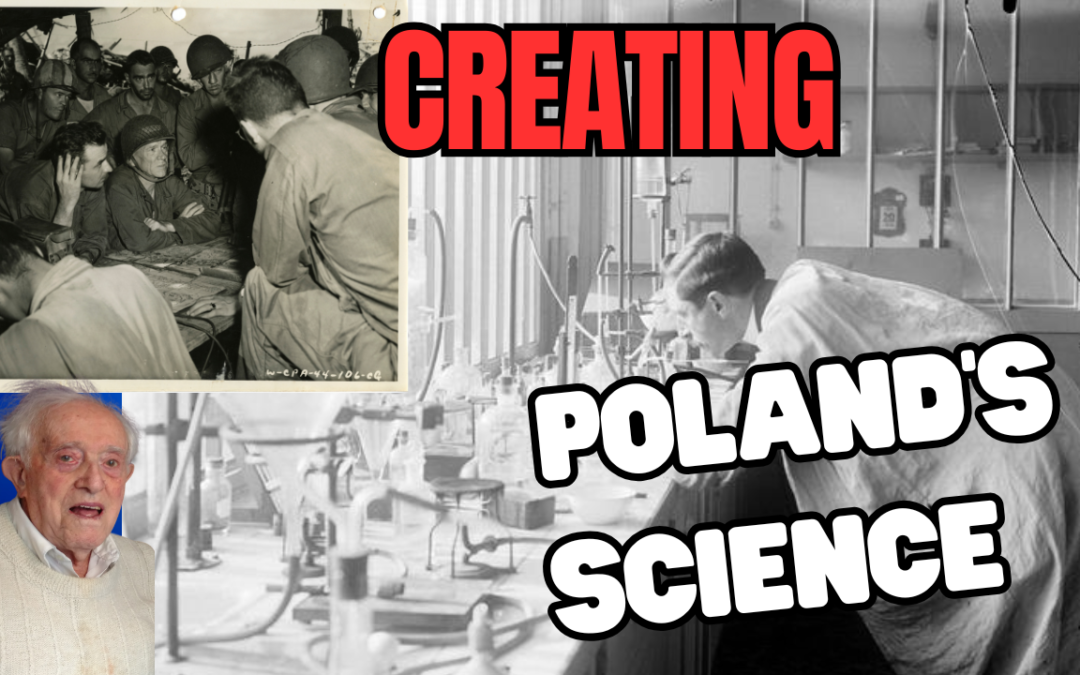
“A moment before she moved away a bit from the window and at that moment the window fell out — she could have been caught with her head out.” A chilling near-tragedy aboard a flight, revealing just how precarious life was in postwar Poland.
I didn’t expect what I would be doing and the magnitude of problems I would have to solve in very short time spans.It’s also probably said already that at the beginning we were a bit constrained because we didn’t have enough space to live, especially when my son was born in November at the end of 1948. I started working at the beginning as an agronomist in the Institute for Plant Multiplication and Seed Production.Sometimes in 1948 later on I was called by the Minister of Agriculture to start organizing a new department at the Agricultural University in Warsaw so that we would be able to start working in the new department in 1949.At this moment I had two problems to solve. One was the matter of housing so that Helena could do more work. She needed someone to take care of our son; otherwise she wouldn’t be able to do that. In the meantime she was also offered some work at the publishing house by a former friend who was very close to us when we started in Moscow.After some time — I don’t remember whether it was already in winter or a bit later — we got the apartment. This enabled Helena to engage a person to take care of our son and also a person to take care of the house. The first person wasn’t especially good and we had to change her. Sometime later — a year or more — we engaged a person who stayed with us until we left Poland. Everyone regarded her as our aunt. She was quite an educated person. Her husband and sons had perished during the war so she was alone on the eastern part of Poland. A professor from Poznań recommended her to us.When this was accomplished Helena could start working. Probably in 1949 or the beginning of 1950 she started working in the chemistry department of the Warsaw Agricultural University as an assistant professor. I also started working as an assistant professor while organizing the new department.We had to renew our contracts each year. Somehow in 1950 or 1951 Helena was called to help organize the plant physiology department in Poznań. She started working there and simultaneously in the Department of Chemistry in Warsaw. Sometimes she worked very hard there and only came back on weekends.I probably told this story already: once when she was flying back to Poznań she was sitting close to the window. A moment before she moved away a bit from the window and at that moment the window fell out. It was very scary because she could have been caught with her head out. But everything was all right — it was only a scare. It shows how things were not yet working too well at that time.Sometime at the end of the 1950s the Minister of Agriculture nominated me acting director of what was called the Central Agricultural Institute. The institute was called to life on 1 January 1951. Its task was not research but the organization of agricultural sciences in Poland.The task was enormous and took a few years until all the changes were made. Here I have to say something about the state of agricultural research in Poland at that time. It was inherited from the pre-war period. There was only one small institute in Puławy, a town east of Warsaw. It was probably organized still at the time of the Russian occupation because it was situated in a previous estate of the Princess Czartoryski. The small institute was not very developed but it had quite a number of older professors and some staff. It also published from time to time the memoirs of the institute.The Minister of Agriculture wanted to create institutes that would encompass all agricultural sciences in the fields of crops, domestic animals, and other agricultural values. I had to take up this task at the beginning with a very small staff hired from people who were working in the Institute for Seed Production. We started working on it.Of course there was a lot of work but also a lot of resistance and the need to persuade the older generation of the need for these changes. The work took almost four to five years. At that time I already had quite a load of things to do.In the new department at the Agricultural University I was nominated head for three years as acting head. In 1952 I was nominated head of the department and in 1954 I received the title of Extraordinary Professor, elected by the faculty of agriculture and confirmed by the school.Sometimes in 1950 I also had to accompany a deputy minister to Białystok Province in order to write a report on how I saw the construction of agriculture there. The region was very poor and the peasants had very small properties on which they could not live. They used very antiquated methods of production. I wrote the report and also met the governor of the province, who later became one of the first people in the security forces in Warsaw.Polish agriculture at that time, until the death of Stalin and in other countries around, was largely collectivized, but not in Poland. There were not many collectives and no one was forced to join. Polish agriculture consisted of very small farms all the time. This constituted quite a lot of problems but also gave the possibility of free exchange of agricultural products.At that time I also started writing quite a lot. One of the first institutes formed had divisions in Warsaw and in Puławy. It was the Institute of Crop and Soil Management. At that time I started to do work in this institute. Helena started working in this institute too — she in the Department of Plant Physiology and I in the Department of Potato Management.I didn’t tell that at that time the president of the country was Bierut, one of the old-type communists. The person who wanted less dependence on the Soviet Union was one of the secretaries of the Communist Party, Gomułka. When Bierut died there was a matter of succession. Gomułka, who was more nationalist, arranged some kind of putsch. Everyone was very uncertain what would happen but I regarded this as a very good development because it introduced for quite a time more freedom of expression and more abilities to work on improving the state in many ways — retail programs, access of peasants to bring produce and sell privately on markets.I regarded this as more promising. I remember this was the time when I bought my son a piano so he could start learning. He was very young and maybe it was a mistake because he didn’t want to do it that much.Let us go back then to the institute. It took me until the middle of 1955 to finish the work and form all the research institutes needed and to find heads for them and places for them to live. Of course it was also a matter of funding the institute, which was very difficult at the beginning. I had many talks with the prime minister and the finance minister and with the secretaries of the party about these matters. At that time I still wasn’t a member of the party.When everything settled and I finished this work I devoted myself more to research problems. In 1954 I was nominated Extraordinary Professor. Helena was also nominated head of the Department of Plant Physiology at the Warsaw Agricultural University. She started working on metabolism in the institute and in the department — on alkaloids and a few other methods.When Gomułka came to power some institutions from abroad started visiting Polish research places, including ours and Helena’s. In 1957 I think it was, I got a Rockefeller Fellowship to go to France and work at the Atomic Energy Agency in Saclay for about six or eight months, then come back and organize the peaceful use of atomic energy in Poland.At that time in 1957 I tried to get somewhere else and we found out that my two sisters had moved to Canada and lived in Montreal. I wanted to visit them and at the same time the McGill University agricultural part in Sainte-Anne-de-Bellevue. So in 1957 when Helena went to Paris I decided to take my son with me and go to see my sisters in Canada.We went with SAS plane to Brussels. From there we had to take a plane in the evening to Montreal. Since we came early in the morning we took a plane to see Helena in Paris and then came back to Brussels and took the plane to Montreal. The flight was at night. We didn’t know what happened until after we landed in Montreal and met my sisters. We found out then that they were very afraid because at the same time another SAS plane going to Montreal had an accident and all people were killed. Luckily it wasn’t us. We immediately informed Helena and the governess at home that everything was all right with us.My son was very close to the governess. At that time he was nine years old and kept a toy bear with him which the governess had given him for the road.I don’t remember how long I stayed in Montreal, visiting and working for some time at the chemistry department in the agricultural part. After some time we had to leave. We stopped in Amsterdam doing some shopping for our son, for myself, and for Helena, and then came home.While in Montreal we met one of my high school colleagues — actually two brothers who were my high school colleagues. Although the acquaintance was quite pleasant and very close, unfortunately after we left one of the brothers with whom we were especially in good relations died suddenly of a heart attack. But we had contacts with his wife for quite a long time thereafter. We also got acquainted with some other people there and I left some of my money with them. It wasn’t much but at that time we put it into bonds with stores. They kept it for us. To some degree it was quite useful when we came back but it wasn’t very much and we couldn’t have lived on it more than two or three months if we hadn’t had other means.When we came back — when Helena came back — it was already the end of 1957 or beginning of 1958. Helena started organizing two isotopic departments: one for the use of isotopes and the other for the use of regulated environment with the use of isotopes for research in regulated environments.At that time when I came back I started working again in all these institutions and research/teaching institutions. I also started working as Deputy Secretary of the Scientific Council of the Agricultural Ministry. This function I actually held until 1967.In the meantime I also started participating in the work of the group delegated as future delegates of the Food and Agriculture Organization of the United Nations. I also started organizing international meetings with the eastern group of countries and with research organizations. The last work was rather very hard and sometimes not very efficient but I managed to make friends in all these countries — especially in the Soviet Union. I had some friends before but now I got friends from the Agricultural Academy in Moscow, the Agricultural Academies of Hungary, Slovakia, Romania, Bulgaria, Yugoslavia and others.I also started organizing meetings with Western institutions and with German institutions. I especially had good relationships with scientists working in Dresden and in Berlin, both on the eastern and western side. I very often visited them either alone or with Helena or Helena alone.Helena cooperated a lot also with East German people who were working on similar matters in her field and visited them quite often. They published quite a number of papers together.I also not only organized the institute but organized the publishing of research and the library, which was a residual library in Puławy. Sometime in the 1960s I organized the central country library located on Krakowskie Przedmieście in the old zone. It was very accurate in collecting all literature from both Eastern and Western sources and buying and lending books to scientists. At the library I also organized a group of scientists who could write more popular pamphlets or small booklets on agricultural matters, which continued working almost until I left Poland.At that time I also started cooperating with the European Journal of Potato Research, which was published in the Netherlands. Poland was the only country of the Eastern Bloc which at the same time was a member of the FAO. I became a member of the delegation to this organization at the same time.Of course I didn’t neglect my writing — papers on agriculture, on agricultural methods which were important to my research in the meaning of my department at the agricultural university. I was occupied with soil properties both physical and chemical, with crop rotations, with soil fertility problems, with weed control and other matters which I particularly elected to deal with, like for instance the management of light soils which prevailed in Poland.I wrote quite a large number of papers myself and with my growing staff at the department. At the same time I also started editing the new Annals of Agricultural Research which had various different parts related to different kinds of research. The Annals had probably eight independent parts which had their own editors but I was the chief editor of all of them and editor of the Agricultural part. There was always a terrible amount of work to do.Looking back to it I can’t understand where I got the time and ability to do all this. But we both worked very hard. Helena did it very hard too but at the same time she didn’t neglect the house. She kept a note also and didn’t do any physical tasks because our son had grown up and didn’t need much help from the governess. She acted like the head of the organizational part of the house with regard to meals, preparing everything, buying things and so on.
Connect with us
Popular posts

Media UP IN ARMS Over Epstein, Complete SILENCE Over 250k English Girls with Worse Fates
“Better a few thousand broken British girls than one awkward dinner party conversation.” The media’s deafening silence on Britain’s grooming gang scandal — while hyperventilating over mean tweets — reveals a “free press” that’s less about truth and more about narrative control.

Blue Team Unfiltered: Their Most “Impressive” Graham Platner Supporters
“From a polite Klansman who ‘didn’t know what the three K’s meant’ to an Antifa guy who loves his Nazi tattoo — Chuck Schumer’s attempt to showcase a ‘broad coalition’ goes spectacularly off the rails in this darkly hilarious political satire.”

FAILURE California: Gives Illegals Free Healthcare While Taxing You to Death
California has become a complete failed state run by corrupt Democrats. In this rant I expose the massive fraud in welfare programs, the disgusting “S…

California Mandates YOUR Tax Dollars Funneled to LGBTQ Businesses. Ideological Capture
“Nothing says ‘fair marketplace’ like the government checking your bedroom preferences before awarding contracts paid by everyone’s electric bills — welcome to California’s ‘supplier diversity,’ where procurement goals make Soviet central planning look merit-based.”
Featured post

Google Declares itself Evil as YouTube SABOTAGES Competition
Google is no longer do no evil company but one that is actively installing an Orwellian nightmare dystopia upon our society and the world.
Latest posts
Media UP IN ARMS Over Epstein, Complete SILENCE Over 250k English Girls with Worse Fates
“Better a few thousand broken British girls than one awkward dinner party conversation.” The media’s deafening silence on Britain’s grooming gang scandal — while hyperventilating over mean tweets — reveals a “free press” that’s less about truth and more about narrative control.
Blue Team Unfiltered: Their Most “Impressive” Graham Platner Supporters
“From a polite Klansman who ‘didn’t know what the three K’s meant’ to an Antifa guy who loves his Nazi tattoo — Chuck Schumer’s attempt to showcase a ‘broad coalition’ goes spectacularly off the rails in this darkly hilarious political satire.”
FAILURE California: Gives Illegals Free Healthcare While Taxing You to Death
California has become a complete failed state run by corrupt Democrats. In this rant I expose the massive fraud in welfare programs, the disgusting “S…
California Mandates YOUR Tax Dollars Funneled to LGBTQ Businesses. Ideological Capture
“Nothing says ‘fair marketplace’ like the government checking your bedroom preferences before awarding contracts paid by everyone’s electric bills — welcome to California’s ‘supplier diversity,’ where procurement goals make Soviet central planning look merit-based.”

0 Comments